Programs
Kenya Program
Summary
The Millennium Water Alliance-Kenya Program (MWA-KP) is a USAID-funded initiative to provide safe water, improved sanitation, and hygiene education (WASH) to areas of rural Kenya impacted by drought and climate change. With the objectives of reducing water-borne illness, promoting integrated water resource management to improve livelihoods, and developing partnerships with beneficiary communities for improved sustainability, MWA-KP is part of the Millennium Water Alliance (MWA), a global coalition of leading WASH-focused relief and development organizations.
Map
Kenya
Background
The Millennium Water Alliance—Kenya Program (MWA-KP) is a USAID-funded initiative to provide safe water, improved sanitation, and hygiene education (WASH) to areas of rural Kenya impacted by drought and climate change. With the objectives of reducing water-borne illness, promoting integrated water resource management to improve livelihoods, and developing partnerships with beneficiary communities for improved sustainability, MWA-KP is part of the Millennium Water Alliance (MWA), a global coalition of leading WASH-focused relief and development organizations.
Program Plan
MWA’s strategy is to improve WASH and environmental health management as critical factors in reducing negative impacts associated with droughts and floods to which the target areas are prone. The key components of this strategy are:
- Improve WASH in homes, health facilities and nutrition centers
- Consolidate management to enhance cost-effectiveness, collective learning opportunities, advocacy, and impact
- Layer, integrate, and sequence emergency relief efforts with long-term development efforts
- Strengthen ties with development programs in other sectors
The program will use the following technical approaches to enact its strategy:
- Prioritize those communities most vulnerable to flood and drought within the five target counties
- Train community water committees on the life-cycle cost approach and connect them with banks and government to enhance long-term system management
- Apply the “3-R” – Retention, Recharge, and Reuse – strategy to increase water storage for use in dry times
- Build water supply using low-cost, resilient technology
- Promote multiple uses of water for income generation
- Promote Household Water Treatment and Safe Storage techniques (HWTSS)
- Apply Community-Led Total Sanitation (CLTS)
- Collaborate with USAID’s APHIAplus program in health facilities and nutrition centers
- Stimulate the local market for WASH materials and the emergence of private sector suppliers
- Utilize multiple avenues for hygiene promotion including radio and participatory education theater
- Use a collective, real-time monitoring system supported through the online FLOW and RSR platforms
- Systematize learning opportunities to replicate successful innovations between implementing partners
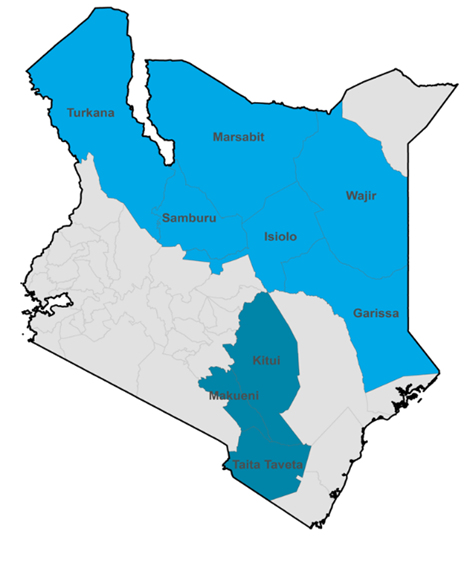
The program will work in five counties with arid and semi-arid lands: Garissa, Isiolo, Marsabit, Turkana, and Wajir. Each of the four member NGOs that comprise the project are responsible for implementation in specific districts of each of these counties.
Goals
The goal of the Kenya Arid Lands Disaster Risk Reduction – WASH Program is to increase resilience to drought and flash floods while simultaneously increasing access to improved water supply and sanitation services and improving hygiene behaviors for poor and vulnerable populations in the arid counties of Turkana, Marsabit (including Moyale District), Garissa, Isiolo and Wajir.
MWA will follow USAID’s three proposed strategic objectives to reach this goal.
Sustainability
In MWA’s program, safe water access will largely be accomplished using sustainable, environmentally friendly, low-cost technologies to retain, recharge, and reuse one of nature’s most valuable resources – rainwater. By significantly increasing natural and artificial water storage capacity in target areas, the program will supplement inadequate groundwater supplies, increasing year-round availability of water and enabling multiple uses of water. MWA and its partners expect to construct or rehabilitate over 60 community ground and rain water schemes and install rainwater harvesting facilities in more than 20 schools.
Water management committees (WMCs) and health management committees (HMCs) will be formed or strengthened for each of the water supply schemes constructed. The life cycle cost approach (LCCA) will be used with WMCs and HMCs to impart an understanding of the true costs of providing water, sanitation, and hygiene services for an entire life-cycle of a service—from implementation all the way through post-construction. With this understanding, local communities, governments and other stakeholders can jointly take action to manage schemes operationally and financially for long-term sustainability.
MWA recognizes that building resilience requires a multi-layered approach: while the main focus of the investment in this program is on access to water and improving environmental health, MWA and its partners are committed to strengthening linkages with other cross-sectoral development programs including USAID’s Arid and Marginal Lands Recovery Consortium (ARC) and upcoming USAID Feed the Future programs to maximize capacity building in target areas on multiple uses of water (MUS) and improve agricultural practices, market linkages, and address the specific needs of livestock and pastoralist communities; with USAID’s APHIAplus to improve WASH coverage in health clinics and nutrition centers and strengthen hygiene and sanitation promotion activities; and with disaster risk reduction programs (DRR) such as the ECHO funded Regional Resilience Enhancement Against Drought program (READ IV) to support resilience building activities.
Finally, beyond simply implementing projects, MWA programs build in structured and systematized learning opportunities and strong sector networking. With lessons learned from implementing this program, MWA and USAID can count as an important outcome the sector-wide sharing of innovations, learning, and evidence-based best practices that can serve as blueprint for future programs to build resilience through cost-effective, scalable WASH programs in the ASALs.